
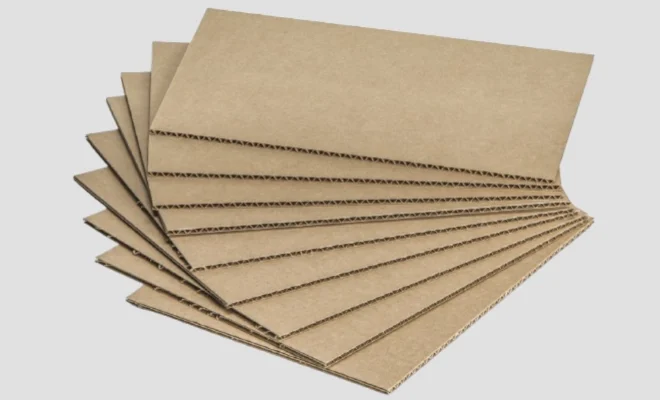
Corrugated cardboard is made of three layers of paper, an inside liner, an outside liner, and a fluted layer in between. The fluted layers provide strength, cushioning, and durability than regular cardboard. That’s why corrugated cardboard is the most common material used in protective packaging. It is widely used to package and protect large, heavy, or fragile products.
Difference Between Corrugated and Cardboard
Let’s discuss the difference between corrugated and cardboard, as the term “cardboard” is often misused to describe a corrugated box.
Cardboard
- Made from paper stock or heavy paper pulp.
- Best for lightweight items and retail packaging.
- Not very protective during shipping.
Corrugated
- Made of three layers: inner liner, outer liner, and a fluted (wavy) layer in between.
- Much stronger and more durable than cardboard.
- Ideal for shipping, storage, and protecting heavier or fragile products.
Liner Materials
Corrugated cardboard is made by combining different liner materials, each serving a unique role in strength and protection. Let’s take a look at what they are:
- Kraft Paper: This is the strong brown paper usually seen on the outside liner of corrugated cardboard. It’s made from 70–80% virgin pulp, which provides durability, tear resistance, and a clean surface for printing.
- Flute Paper: This is the wavy layer placed between the liners. It is made of 100% recycled fibers. It creates air pockets that provide cushioning, stacking strength, and protection for products.
- Test Paper: This is a cost-effective liner made from recycled fibers. It’s usually used on the inside liner of corrugated cardboard and is less strong than kraft, but still effective for protection.
Corrugated Flute Types
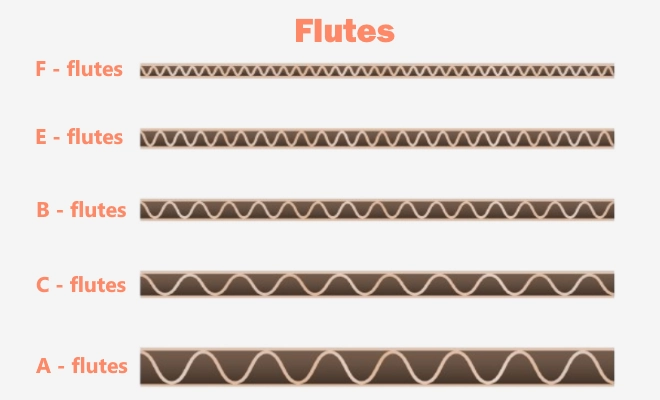
Corrugated cardboard consists of various flute types. Each flute is designed to provide strength, cushioning, and quality printing. They are as follows:
- A Flute: A flute has a large flute, usually around 1/4 inch thick. It gives excellent cushioning and is best for handling and stacking fragile items.
- B Flute: B flute is thinner, about 1/8 inch. It offers good stacking strength, puncture, and crush resistance. It offers high-quality printing and smooth die-cutting.
- C Flute: C flute is the most widely used, around 3/16 inch. It balances strength, cushioning, and printing surface.
- E Flute: E flute is much thinner, about 1/16 inch. It gives a smooth surface for printing and is often used in cosmetic or electronics packaging.
- F Flute: F flute is even thinner, around 1/32 inch. It’s lightweight and great for small, delicate products with detailed printing.
Different Combinations of Flutes
- AC Flutes: A mix of A flute and C flute. Provides strength for heavy shipping.
- BC Flutes: Combines B flute with C flute. They are widely used for packaging and shipping.
- EB Flutes: A combination of E flute and B flute. Ideal for retail packaging where print quality and durability both matter.
Types of Corrugated Cardboard
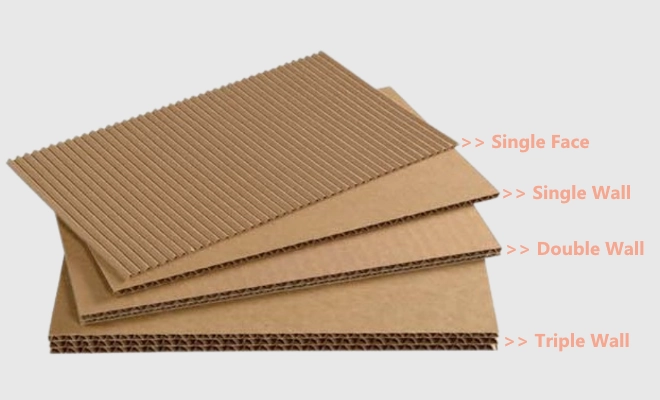
Corrugated cardboard is made in different layers depending on the strength and protection needed. Here are the main types:
- Liner Board: The flat outer layers that cover and protect the corrugated flutes. They give structure and a printing surface.
- Single Face: Made with one liner board and one flute layer. It’s flexible and mostly used for wrapping or extra cushioning.
- Single Wall: The most common type with two liners and one flute in between.
- Double Wall: Built with two flute layers and three liners. It’s stronger and often used for heavy or fragile products.
- Triple Wall: The strongest option with three flute layers and four liners. It is used for very heavy-duty shipping.
Pros and Cons of Corrugated
Here are some pros and cons of corrugated cardboard as a packaging material:
Pros:
- Cost Efficiency: Affordable to produce and ship.
- Eco-Friendliness: Made from recyclable and biodegradable materials.
- Customisation: Easy to print, brand, and design in different shapes and sizes.
- Protection and Durability: sturdy enough to protect items during shipping and handling.
Cons:
- Limited Weather Resistance: Not very effective against water, humidity, or extreme conditions without extra coatings.
- Bulkier Storage: Takes up too much space.
Conclusion
Corrugated cardboard is a strong and versatile material used widely in packaging. Its fluted structure provides cushioning, durability, and protection, making it suitable for different products. It is cost-effective, eco-friendly, and easy to recycle, which adds to its value as a packaging choice. Because of these qualities, corrugated cardboard is considered one of the most important materials in the packaging industry.
